About
Collection Highlights
The Collection of the Pennsylvania Barge Club, which dates from 1861, roughly falls into three eras. From its founding in 1861 to 1885 Pennsylvania Barge dominated in single sculling, winning most of the early events recorded on the engraved plates of the Schuylkill Navy Champions Belt, especially seven-time champion Max Schmitt.
The great American realist painter Thomas Eakins, who rowed with high school friends at the Club, completed all the works of his “rowing period” at this time between 1871 and 1874. Unfortunately, we have very few objects from this era, except for the race histories recorded on the Champions Belt, and published archival material by the Schuylkill Navy. We do have an original membership certificate and a trophy from 1870, a wooden model oar painted in the colors of the blade used by Max Schmitt, and various early plaques.
From about 1890 to 1900, Pennsylvania Barge dominated in many sweep and sculling events and won the prestigious Commodore’s Award Shield in 1899. In this same year, the Schuylkill Navy History by Sill, et al. stated that Pennsylvania Barge had won the most championship races since 1858 in the “Schuylkill Navy, Cup and People’s Regattas.” This period was the prime of champion single sculler, James Juvenal. It also saw the Club winning three consecutive NAAO championships in the Senior Eight event.
An interesting highlight of this period is that James Juvenal, together with John Exley and Edward Marsh from the 1896-1899 National Champion Eight, were recruited by Vesper Boat Club for their early Olympic program. Those three were in the winning crew of the Olympic Eight in 1900. They remained with Vesper until the next Olympic cycle in 1904, in which Juvenal won a bronze medal in the Singles, and Exley and Marsh won another gold medal in the Eight. All three then returned to Pennsylvania Barge to complete their careers.
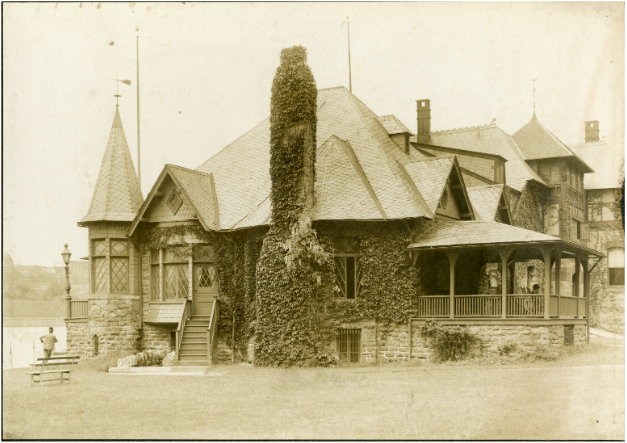
Other than published materials, we had few archives or artifacts from this era until we discovered some in storage at Vesper Boat Club during development of the Rowing History Project. They include 10 original photographs relating to Juvenal, Exley, and Marsh together with crews from the 1896-1899 Eight, a detailed photo of the Pennsylvania Barge boathouse and photos of other Club scullers from the era. Hilary Langer, a Vesper officer and RHP team member, graciously donated these photos to Pennsylvania Barge. We consider them to be among our most precious objects and had them digitally restored. One is a victory photo of the 1899 NAAO Eight on the water, at rest, behind Peters Island, with James Juvenal in a single shell, at rest, next to them. Juvenal’s pose is similar to that of Max Schmitt in Eakins’ 1871 painting which now hangs in the Metropolitan Museum of Art.
Another treasured photo from Vesper is the full body victory photo of Juvenal in a single after the 1905 Middle States Regatta in which he competed for Pennsylvania Barge. How did these photos come to be stored at Vesper? We don’t know, but a logical conclusion is that many of the objects on display at the Club in 1955 found their way into other collections when Pennsylvania Barge that year shut down as a rowing organization and did not reconstitute itself for the next 50 years
The third important era in our history is roughly 1918 to 1932. Club oarsmen represented the USA at the Olympics in Antwerp in 1920, Paris in 1924, Amsterdam in 1928 and Los Angeles in 1932, winning five medals in pairs and fours. Some objects from this era were donated to Pennsylvania Barge by surviving family members and friends of the Club, including Michael Ragan, Ken Shaw, Lois Trench-Hines, Sophie Socha, James Hill, Rick Stehlik, Hilary Langer, Chris Doyle and David Drew. Among the most significant objects are Joseph Schauers’ gold medal for the Coxed Pairs victory at the 1932 Los Angeles Olympics, including his blazer, lapel pin, athlete badge and athlete identification number. Also gifted was Charles Kieffer’s 1932 gold medal from that same race. Ernestine Bayer contributed numerous archival materials related to her father, Ernest Bayer, including his silver medal Olympic Diploma from the 1928 Amsterdam Olympics .
After recouping these artifacts from The Olympic Years, the Club commissioned a graphic artist to create a large poster celebrating the victories of this period, which is on display in the boathouse’s second floor.
The permutations of the Pennsylvania Barge Club, including its periodic financial problems and its 50-year hiatus as a rowing club, help explain the losses of early historical artifacts.
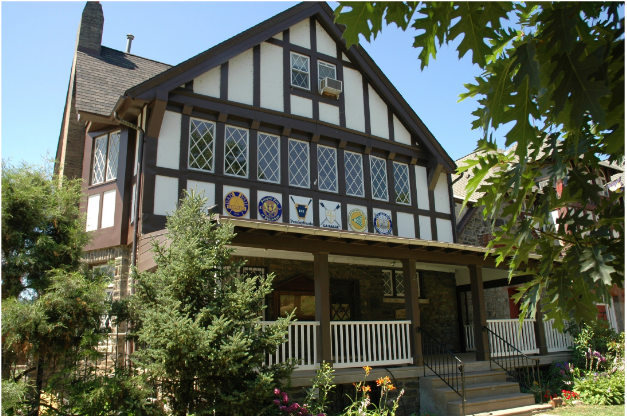
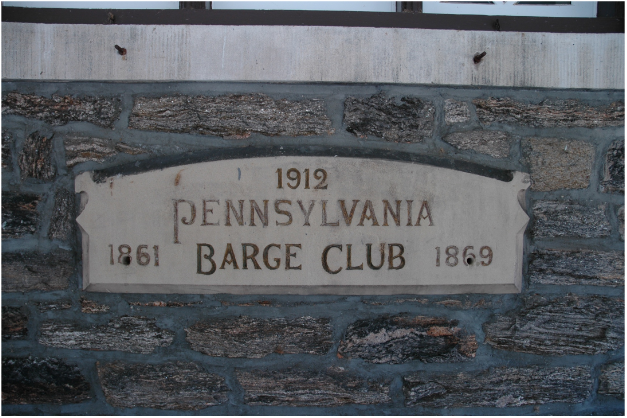
The Club was founded in 1861 and initially occupied space in the Quaker City Barge Club, now the boathouse of Fairmount Rowing Association. Then, in 1869, it moved to its present location – to a newly built boathouse, with a major addition completed in 1912. The Club thrived and prospered until World War II, in which many of the members were casualties. By the end of the Korean War, the Club had lost so many members that the leadership decided to disband the club as a rowing organization as that was no longer financially viable. The Club formally resigned from the Schuylkill Navy in 1955 and its officers formed a new entity to oversee the boathouse as an administrative hub for amateur rowing organizations. Separately, the boat bays and docks were leased to Drexel University for their rowing team beginning in 1958.
Hundreds of artifacts and archival materials did survive the Club shut-down in 1955, but Ernestine Bayer, who grew up in the club when her father presided over it, recalls vividly that there were many more objects in the Club collection than exist today.
As an administrative hub, the boathouse was leased to many organizations over the years for office and meeting space. These included the Schuylkill Navy of Philadelphia, Middle States Regatta, Dad Vail Regatta, NAAO, Schoolboy Rowing Association, USRA, Philadelphia Adaptive Rowing and others. In 2007, after Drexel University’s growing rowing program moved to the Bachelors Barge Club, the Officers decided to reinstate the Pennsylvania Barge Club as a nonprofit 501(c)3 rowing organization. It rejoined the Schuylkill Navy in 2008.
The intention was to resume rowing operations with boats and equipment for members, and to lease some rowing space to a high school or college tenant.
In 2009, the Club undertook a major building renovation to install new infrastructure and to convert interior spaces from offices back to the original 1912 layout of locker rooms, dining facilities, meeting spaces, and display spaces.
During the renovation, the Club leadership vowed to preserve as much as possible of the 1869 and 1912 structures, and also preserve and display the remaining archives and artifacts. Every interior space was designed with an eye toward displaying Club history.
Important paper archives were transferred in 2011 from the boathouse to the Historical Society of Pennsylvania for custody and preservation. Since then, all original photos have been digitized and reframed under UV glass and all textile banners enclosed in UV glass. All paper archives remaining at the Club have been enclosed in acid-free folders. When the windows throughout the entire second floor were replaced in 2017, UV glass was intentionally specified due to the large number of objects on display.
Today, Pennsylvania Barge has private rowing members, and La Salle College High School has a long-term lease with the Club that began in 2010. Interestingly, Pennsylvania Barge is where La Salle high school rowing got started in 1927. The captain of that first team was none other than Charles Kieffer who would go on to become a 1932 Olympic gold medalist. The early La Salle team was coached by Earle Baltz, who was a great single sculler, President of Pennsylvania Barge, and later Commodore of the Schuylkill Navy.
Recovering the history of Pennsylvania Barge is an on-going process. There are many objects and archival materials still out there, waiting to be found. In 2024, the Rowing History Project received an email from a jewelry store in New Jersey, announcing a collection of rowing medals for sale, with detailed photos of each medal. The medals had been awarded to Earle and Frank Baltz, single scullers for Pennsylvania Barge in the 20’s and 30’s. Unfortunately, we did not respond to the email until the following day, and by that time, the medals had been sold. Attempts to identify the buyer to make a counter-offer were unsuccessful. At least, we have photos of the medals, which were ornate in that era, and they provide background on the careers of these two great scullers. One of the medals was awarded to Earle Baltz when he retired as Commodore of the Schuylkill Navy. We were aware that he served as Commodore, but we did not know that he was the subject of a Commodore’s Review event – the Schuylkill Navy’s highest honor, reserved for notable people in the Philadelphia rowing community and public officials.